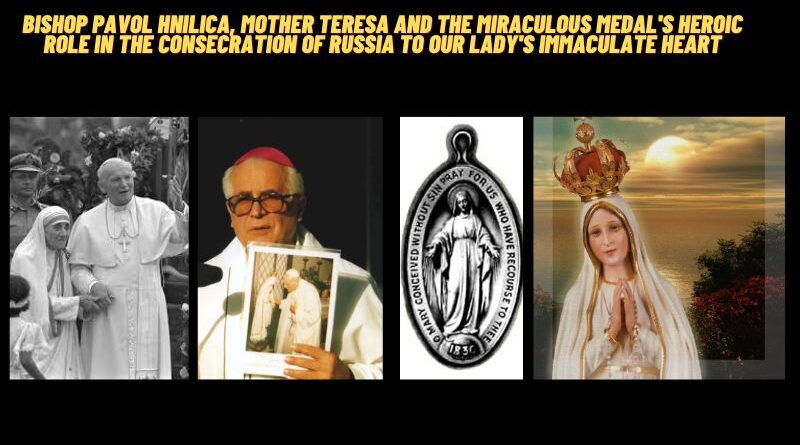
Bishop Pavol Hnilica, Mother Teresa and The Miraculous Medal’s Heroic Role in the Consecration of Russia to Our Lady’s Immaculate Heart
Key Points
- Research suggests Bishop Pavol Hnilica played a heroic role in entering Moscow in 1984 to consecrate Russia to the Immaculate Heart of Mary, aligning with Pope John Paul II’s wishes.
- Mother Teresa was instrumental in organizing this mission, providing Miraculous Medals as symbols of devotion.
- The evidence leans toward the Miraculous Medal being central, both spiritually and practically, in this clandestine act.
Background
The consecration of Russia stems from the 1917 Fatima apparitions, where the Virgin Mary reportedly requested this act for world peace. Pope John Paul II, in 1984, performed a public consecration, but Bishop Hnilica’s secret mission inside Moscow added a unique dimension, reflecting the Cold War’s tensions and Catholic devotion.
Bishop Hnilica’s Mission
On March 25, 1984, Bishop Hnilica, a Slovak prelate with a history of defying communist oppression, entered Moscow as a tourist. He secretly celebrated Mass in the Kremlin’s Assumption Cathedral and recited a consecration prayer, synchronized with Pope John Paul II’s act in Rome, placing a Miraculous Medal under the Patriarch’s throne.
Mother Teresa and the Miraculous Medal
Mother Teresa, inspired by Fatima, orchestrated the mission, providing Miraculous Medals blessed by the Pope. These medals, believed to bring grace, were smuggled past Soviet security and left in the Kremlin, symbolizing Mary’s presence and aiding their passage through customs.
Survey Note: Detailed Account of Bishop Hnilica’s Role and the Consecration of Russia
Introduction
In 1984, amidst the ideological divide of the Cold War, a clandestine mission unfolded that intertwined faith, courage, and devotion to the Virgin Mary. Bishop Pavol Hnilica, a Slovak prelate known for his resilience under communist oppression, played a pivotal role in fulfilling a divine request from Our Lady of Fatima: to consecrate Russia to her Immaculate Heart. This mission, synchronized with Pope John Paul II’s public consecration on March 25, 1984, involved entering Moscow under perilous circumstances to perform a secret act inside the Kremlin. Central to this endeavor were Mother Teresa of Calcutta, who orchestrated the plan, and the Miraculous Medal, a symbol of Marian devotion that played both spiritual and practical roles. This survey note explores the historical context, the mission’s execution, and the significance of key figures and symbols, providing a comprehensive account for those interested in Catholic history and devotion.
Historical Context: The Fatima Mandate
The story begins with the Marian apparitions at Fatima, Portugal, in 1917, where three shepherd children—Lucia dos Santos, Francisco Marto, and Jacinta Marto—claimed to have seen visions of the Virgin Mary. According to Lucia, later known as Sister Lucia, Mary requested that Russia be consecrated to her Immaculate Heart by the Pope in union with all bishops worldwide. This consecration was intended to bring about Russia’s conversion from its errors—interpreted as the spread of communism—and to usher in an era of world peace. The message warned that failure to heed this request would lead to further wars and persecution of the Church.
Over the decades, several popes attempted to fulfill this request. Pope Pius XII consecrated Russia in 1952 but did not involve all bishops globally, as requested. Pope Paul VI made a similar consecration in 1964 without explicitly naming Russia. The debate persisted over whether these acts met Our Lady’s conditions, with some Catholics arguing for a more explicit and unified consecration. It was Pope John Paul II, deeply devoted to Mary and having survived an assassination attempt he attributed to her protection, who took definitive steps to ensure fulfillment. On December 8, 1983, he sent a letter to all bishops worldwide inviting them to join him in an Act of Entrustment to the Immaculate Heart of Mary on March 25, 1984—the Solemnity of the Annunciation. Although he did not publicly name Russia to avoid political complications during the Cold War, he entrusted “all men and nations” in need, implicitly including Russia. Sister Lucia later confirmed that this act fulfilled Our Lady’s request, as noted in Consecration of Russia to the Immaculate Heart of Mary – Wikipedia.
Bishop Hnilica’s Heroic Role
While Pope John Paul II performed the consecration publicly in St. Peter’s Square, Bishop Pavol Hnilica undertook a secret mission inside Russia itself. Born in 1921 in Slovakia, Hnilica was ordained a priest in 1950 and consecrated a bishop in 1951 under communist rule in Czechoslovakia. His early life was marked by persecution; he was imprisoned and later fled to Rome to continue his work under Pope Pius XII’s protection. Hnilica’s deep devotion to Mary and his close friendship with Pope John Paul II made him an ideal candidate for a mission of extraordinary audacity: to enter Moscow and perform a consecration within the Kremlin itself at the same time as John Paul II’s act in Rome.
In February 1984, Hnilica traveled to Calcutta to meet Mother Teresa, who had been inspired by Our Lady of Fatima’s messages about Russia’s conversion. Mother Teresa had long prayed for Russia’s spiritual renewal and had even sent rosaries and Bibles secretly into the Soviet Union, as detailed in Mother Teresa’s Secret Effort To Consecrate Russia | Stephen Ryan. She saw an opportunity to make a profound impact by placing a Miraculous Medal—a Catholic devotional object originating from an 1830 apparition of Mary to Saint Catherine Labouré—in the Kremlin during Pope John Paul II’s consecration. Mother Teresa arranged for Hnilica and his companion, Monsignor Leo Maasburg (her spiritual advisor), to enter Moscow as tourists on their way from Calcutta to Rome. They were to visit Moscow for three days under the guise of sightseeing but with the true purpose of carrying out a spiritual mission.
On March 25, 1984, Hnilica and Maasburg entered the Kremlin amidst heavy surveillance. Religious articles were strictly forbidden in the USSR, so they smuggled hundreds of Miraculous Medals past Soviet customs by using them to persuade agents—sometimes even handing out medals to gain favor, as noted in Pavol Hnilica – Wikipedia. Inside the Kremlin, they visited the Assumption Cathedral, a historic site dedicated to Mary. There, Hnilica secretly celebrated Mass using a piece of bread and wine he had brought with him—an act of profound faith in a place where religious expression was suppressed. Hiding his consecration prayer behind a copy of the Soviet newspaper Pravda, Hnilica recited it in harmony with Pope John Paul II’s consecration thousands of miles away. He then discreetly placed a Miraculous Medal under the Patriarch’s throne in the cathedral, leaving a hidden symbol of Marian devotion at the heart of Soviet power.
The mission was fraught with danger. Hnilica later described his fear during the operation but noted that the presence of numerous tourists provided some cover. After completing their task, they returned to their hotel and left for Italy that afternoon. Upon returning to Rome, Hnilica reported back to Mother Teresa, who was overjoyed at their success, as mentioned in the Patheos article.
Mother Teresa’s Strategic Involvement
Mother Teresa’s role was instrumental in planning and executing this mission. A fervent devotee of the Miraculous Medal, she believed it was a powerful instrument of grace and conversion. The medal, inscribed with Mary’s image and the words “O Mary, conceived without sin, pray for us who have recourse to thee,” was central to her missionary work. She distributed these medals widely and believed they had a special role in bringing faith to Russia. For this mission, she provided Hnilica and Maasburg with medals blessed by Pope John Paul II, ensuring they were spiritually prepared for their task.
Mother Teresa’s vision for the consecration was bold and precise. She chose March 25, 1984, knowing it coincided with Pope John Paul II’s consecration, and insisted that a Miraculous Medal be placed in the Kremlin to spiritually unite Russia with Mary’s Immaculate Heart. She arranged Hnilica’s visa and air tickets through the Russian Consulate and ensured a month of preparatory prayer involving her nuns in Calcutta, though she kept the mission’s details secret. Her faith in the medal’s power was unwavering; she believed its presence in the Kremlin would amplify the spiritual impact of the consecration. After the mission, she continued her work for Russia’s conversion, eventually establishing numerous convents there after communism’s collapse, matching the 20 mysteries of the Rosary (15 traditional + 5 added by Pope John Paul II), as noted in the Patheos article.
The Role of the Miraculous Medal
The Miraculous Medal played a pivotal role in this story, both symbolically and practically. Symbolically, it represented Mary’s intercession and protection, bringing her presence into a place where religious expression was outlawed. Its placement in the Assumption Cathedral—a site dedicated to Mary—was a profound gesture of faith, especially in a nation under communist rule. Practically, Hnilica’s use of the medals to navigate Soviet security underscored their perceived power; customs agents who received them reportedly softened their stance, allowing Hnilica and Maasburg to proceed unhindered. This dual role—spiritual symbol and practical tool—highlighted the medal’s significance in both Catholic devotion and this historic mission.
Impact and Legacy
The 1984 consecration marked a turning point in Catholic history. Sister Lucia later confirmed that Pope John Paul II’s act fulfilled Our Lady’s request from Fatima, as noted in Consecration of Russia to the Immaculate Heart of Mary – Wikipedia. Many Catholics attribute subsequent events—such as the fall of communism in Eastern Europe and the Soviet Union—to this act of faith. Bishop Hnilica’s mission, though little-known at the time, exemplified the courage of those who defied communist oppression to uphold religious devotion. His close ties to Pope John Paul II and Mother Teresa, as well as his later support for Marian movements like Medjugorje, cemented his legacy as a fearless advocate for Mary’s intercession.
Mother Teresa’s legacy includes her tireless work for the poor and her role in this historic mission, which remained largely unknown until after her death. The consecration of Russia—bolstered by Hnilica’s heroism and Mother Teresa’s vision—stands as a testament to the power of prayer and devotion in overcoming adversity. As Our Lady of Fatima promised, “In the end, my Immaculate Heart will triumph.”
Detailed Analysis Table
To organize the key aspects of this event, consider the following table summarizing the roles and significance:
| Aspect | Details |
| Bishop Hnilica’s Role | Entered Moscow on March 25, 1984, performed secret consecration in Kremlin, celebrated Mass, placed Miraculous Medal. |
| Mother Teresa’s Involvement | Orchestrated mission, provided Miraculous Medals, arranged travel, ensured prayer preparation. |
| Miraculous Medal | Symbol of Marian devotion, smuggled past security, placed in Kremlin, aided passage through customs. |
| Historical Context | Cold War tensions, communist oppression in USSR, Fatima apparitions requesting consecration. |
| Impact and Legacy | Contributed to fall of communism, confirmed by Sister Lucia, inspired Marian movements. |
This table encapsulates the multifaceted nature of the event, highlighting the interplay of faith, strategy, and historical context.
Conclusion
The story of Bishop Pavol Hnilica’s secret mission to co
Key Citations
- Consecration of Russia to the Immaculate Heart of Mary Wikipedia page
- Pavol Hnilica Wikipedia page
- Mother Teresa’s Secret Effort To Consecrate Russia article
13 web pages